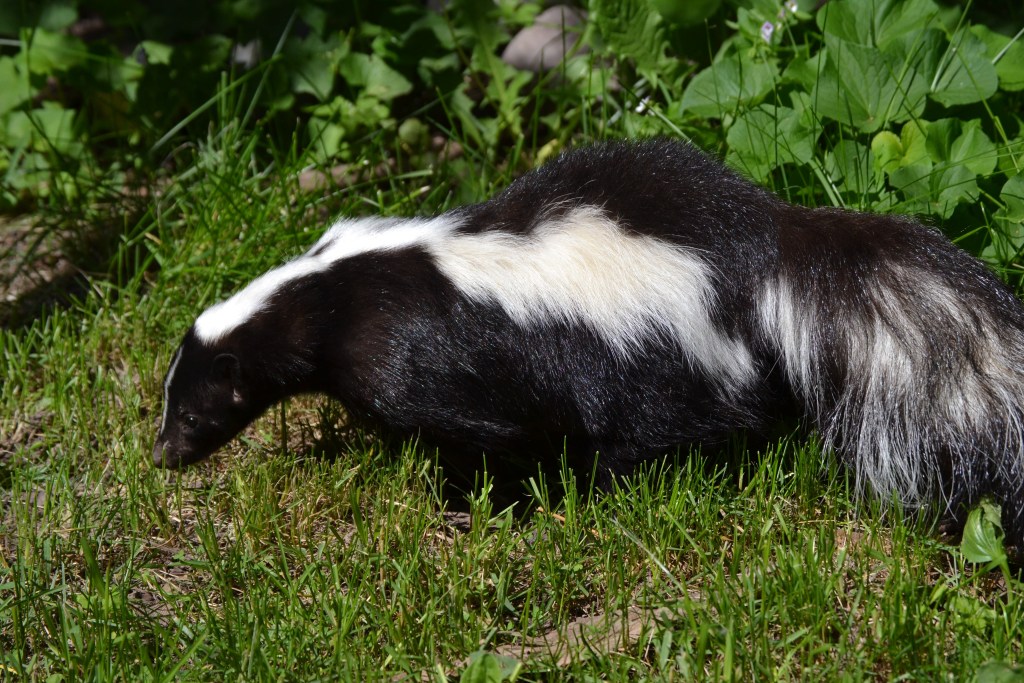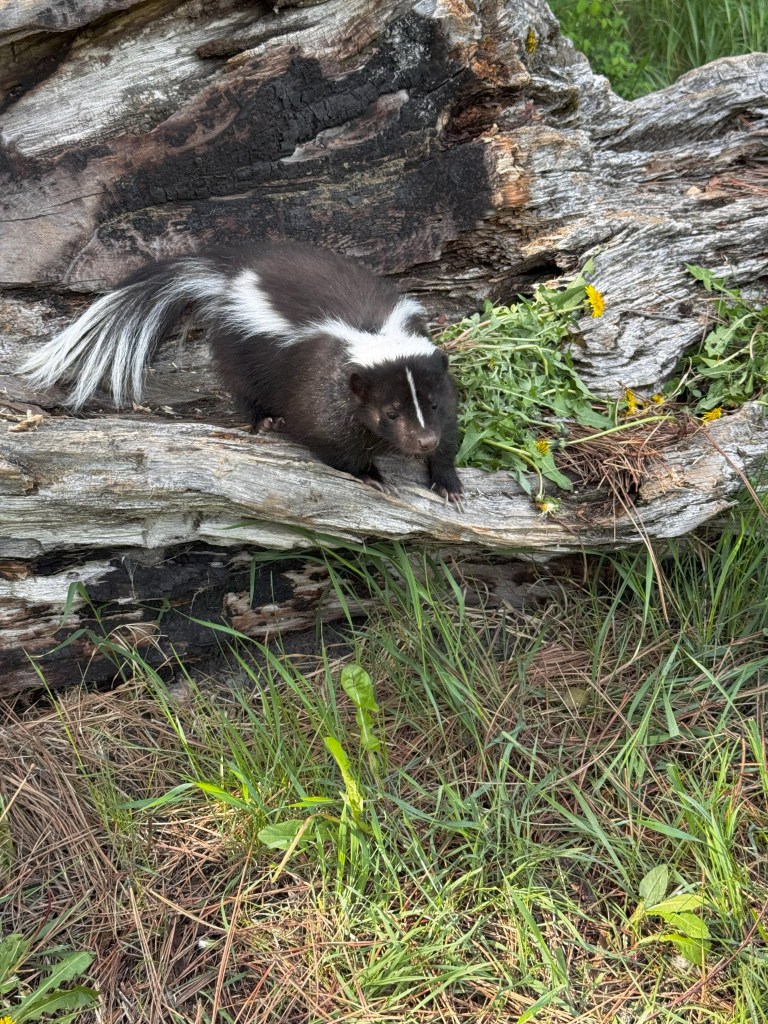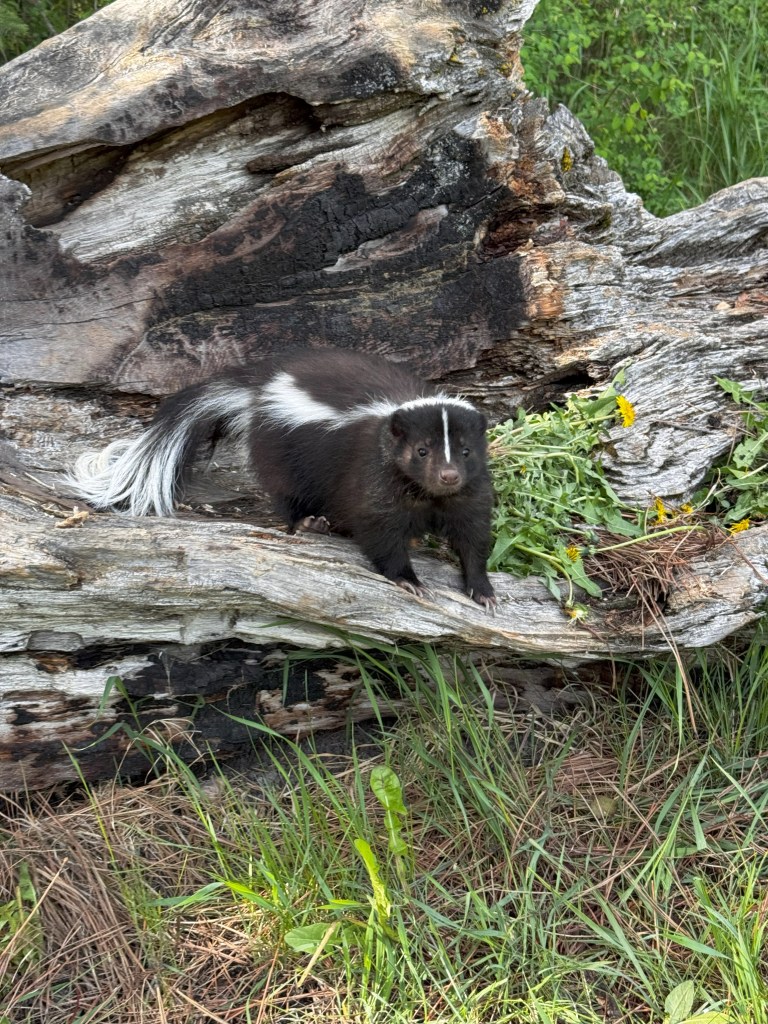
Striking, clever, and full of personality, striped skunks are surprisingly charming animals to observe and photograph. At Triple D, photographers can capture their bold black-and-white markings, curious expressions, and distinctive behaviors in a natural setting. While famous for their defensive spray, these skunks are calm and approachable under professional supervision, making for a unique and memorable photography experience.
Scientific Name
Mephitis mephitis
Common Names
Striped Skunk
Description
Striped skunks are small to medium-sized mammals, easily recognized by their bold black fur with white stripes running from head to tail. They have a stout body, short legs, and a bushy tail, which they can raise dramatically when threatened. Skunks are primarily nocturnal and omnivorous, feeding on insects, small mammals, fruits, and vegetation. Despite their infamous scent, skunks are intelligent, inquisitive, and capable of fascinating behaviors that make them compelling subjects for wildlife observation and photography.
Filming Site
Our skunk sessions take place near brushy areas and open spots on the ranch, simulating their natural habitat. Photographers can capture them foraging, exploring, or simply pausing to look at the camera, with backdrops that highlight their distinctive markings. The setting is designed to provide clear views and safe interactions while maintaining a natural environment.
When Should You Visit
Striped skunks can be seen year-round, with the best activity occurring in the cooler parts of the day — typically early morning or late afternoon. Spring and summer often reveal playful or exploratory behaviors, while autumn highlights their striking contrast against natural fall backdrops. These sessions allow photographers to capture both expressive portraits and natural behaviors in a safe, controlled environment. Consider attending April and November when there may be fewer participants.
What To Expect
The striped Skunk channels its inner sloth, never exceeding a modest speed. The trainer will encourage the Skunk to move around the filming location, taking advantage of the natural features.
Standing, kneeling, and sitting are permitted. Many photographers prefer to be lower as the skunk can be approached to a short distance. Kneeling allows you to easily reposition yourself for different angles of the skunk.
What You Should Know
Basic skills with your camera to:
- Set exposures for a dark subject;
- Optionally apply automatic bracketing to address challenging exposure.
Photographers opting to apply bracketing should be able to:
- Enable and disable automatic bracketing (exposure or ISO);
- Set the size of the exposure increment;
- Set the number of shots in the bracketing sequence.
If you use a tripod, you should be able to quickly change the height, especially important when transitioning between standing and kneeling or sitting.
What You Should Bring
Achieving the correct exposure on a black and white subject in a forest setting is challenging. A larger aperture lens provides the most exposure flexibility. The skunk will be relatively close during the session. A 70-200 or medium telephoto macro lens, for example 100, is a good choice for photographing the Skunk.
Extra batteries and memory cards as there is nothing worse than running out. Unlike searching in the wild, a Triple D Spotted Skunk model is present throughout the entire filming session and many photographers take more photos in several minutes than they would in an entire day.
Whether you are a professional, advanced amateur or hobbyist, being comfortable and confident with your equipment is the key success. If you have recently acquired a camera, you should still bring your old camera as a backup. There is nothing worse than struggling to do something with a new camera that you easily accomplished with your old one.
Even if you’ve owned your equipment for years, bring the manual(s) in case there is a setting you rarely or have never used. Loading manuals on your smart device provides convenient access.
A second camera:
- Provides a backup should an equipment failure occur;
- Allows you to continue the session when a battery is depleted or a memory card is full;
- Allows you to continue when your buffer is full;
- Can be equipped with different lenses (macro and zoom);
- Can be set with a different exposure to easily transition between darker exposures and high-speed action.
First time attendees are often surprised by the large number of photographs they capture. Secondary storage devices are recommended.
If you prefer using a tripod than a quick release system is recommended as you may want to handhold your camera to capture some of the action.
Precipitation may occur year- round on the west side of the Rocky Mountains, ranging from rain to sleet to wet snow. Rain protection for your equipment will reduce your anxiety in these situations.
Kneepads can be comforting when you choose to kneel for extended periods. A small portable stool or cushion may be used while sitting.
What You Should Do
Bring everything you need, including memory cards and batteries, to the photo session. You cannot leave the shooting compound once filming begins.
We’ve all done it one time or another, we’ve all been guilty of chimping. Minimize chimping during the photo session as it decreases battery life and increases the likelihood of missing a great shot.
Do not touch the animal, the operating permits prohibit public contact with the Triple D animals.
Staying together as a group helps the trainer guide the animal to look in your direction. Consider moving within the group to capture photos from a different perspective and allow others to photograph from your position.
Do not call out to the animal or make any noises in order to get its attention. A successful session is only possible when the animal is focused on the trainer.
Silence your phone and do not answer or make phone calls.
Participant covenants and agrees that it will not photograph nor distribute, publish or make public in any manner photographs of:
(1) Any of Providers facilities, including, without limitation, cages, pens, or exercise areas;
(2) Any of the Subject Models when on a leash or in cages or pens;
(3) The Trainers or any of Provider’s employees, either with or without the Subject Models without Providers prior written authorization.