Capture the charm and agility of the pine marten – one of North America’s most secretive forest dwellers. At Triple D, our trained pine marten offers photographers a rare opportunity to create stunning, lifelike images that reveal its sleek beauty and playful nature. Whether you’re a seasoned wildlife photographer or just starting out, this session provides a unique and unforgettable subject for your portfolio.
Scientific Name
Martes americana
Common Names
American Marten, North American Marten & Pine Marten
Description
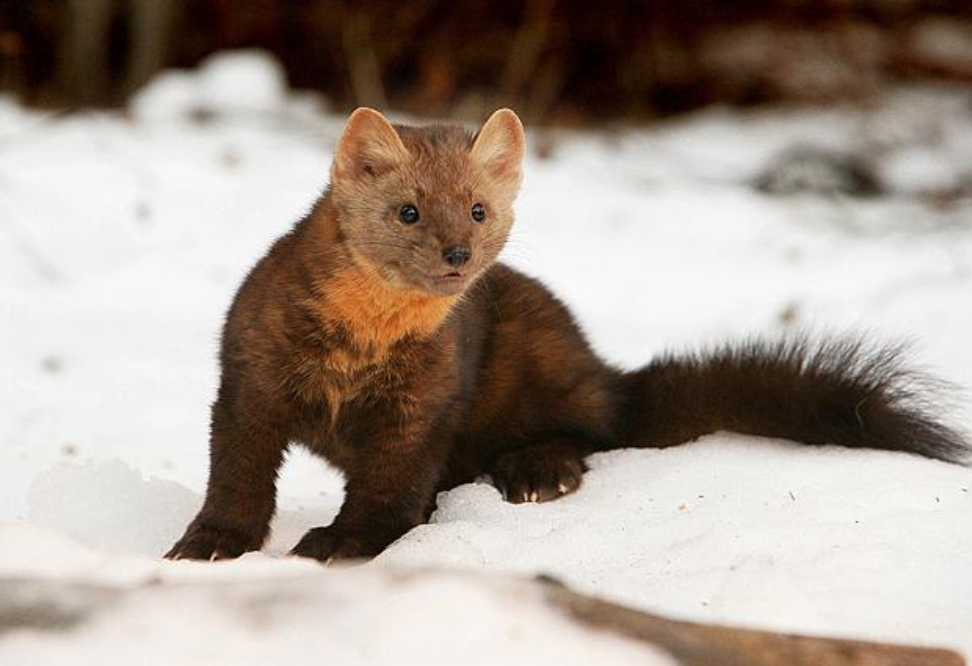
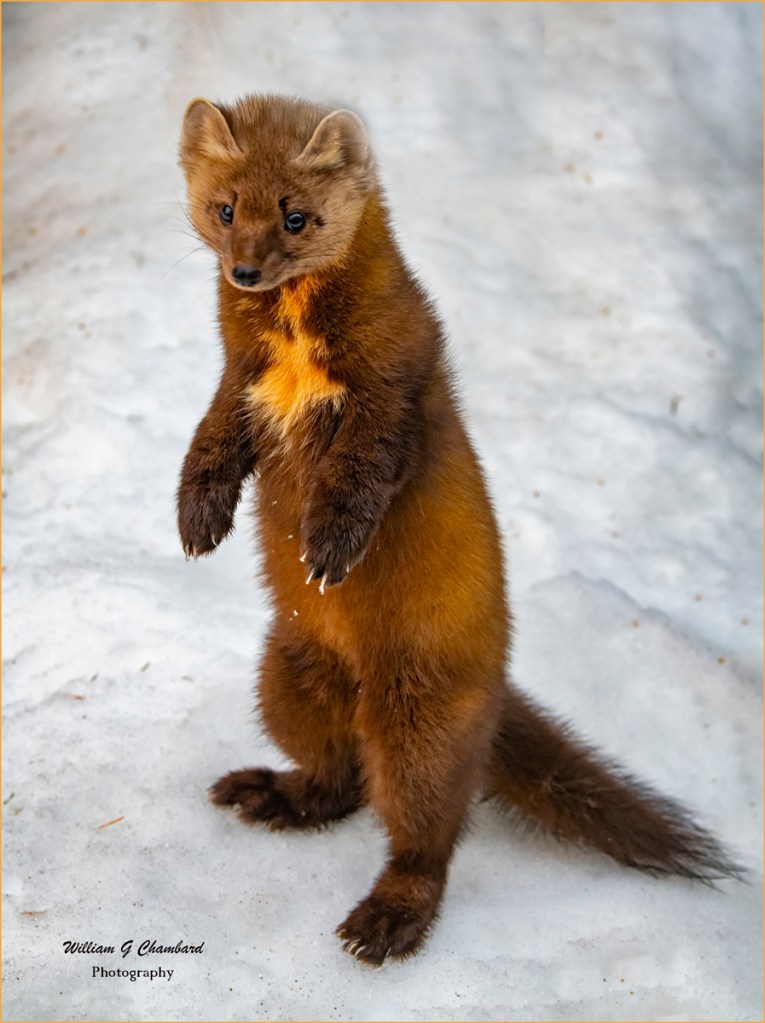
Martens are a slender weasel with a bushy tail, and a pointed face. They have short legs with rounded ears and large black eyes. The legs are darker than the body. The winter coat is dark brown with a bright orange throat patch while the summer coat is lighter in color and not as thick.
Filming Site
The filming site represents the mixed woods forests inhabited by martens. Although the site is limited in size to ensure the marten remains visible to the photographers, it includes trees, brush, open areas, water and logs.
When You Should Visit
Martens should be photographed throughout the year to capture the variations in coat color and thickness. Late spring/early summer baby sessions may feature kits. Winter provides an opportunity to capture images on snow.
What To Expect
A Marten is what the energizer bunny aspires to be. Marten sessions are a high energy exploration of the filming compound. Marten sessions may include opportunities on the ground, in trees, and on logs. The trainer will endeavour to position the marten on a range of the features within the filming site.
The Marten exemplifies the curiosity of the weasel family. The marten may move through hollowed logs, stopping when exiting to give photographers a brief moment to capture its curious nature.
The activity is low, from ground level to approximately 5 feet. Although standing is permitted, kneeling or sitting is recommended. Standing may result in branches interfering with your line of sight and your camera point downward at a steep angle.
What You Should Know
Basic skills with your camera to:
- Use higher shutter speeds and continuous auto focus to photographic action.
- Set exposures for various conditions ranging from bright sunlight to shade;
If you use a tripod you should know to configure it for use when kneeling or sitting.
What You Should Bring
Martens are quick and the filming site is shady, therefore a larger aperture lens is beneficial. The distance to the marten and height off the ground may vary, a 70- 200 works well in these situations. A lens with a minimal focusing distance of 6 feet or less is also useful. A medium telephoto macro lens, for example 100 f2.8, ensures you never miss an opportunity because the marten was too close.
Extra batteries and memory cards as there is nothing worse than running out. Unlike searching in the wild, a Triple D Marten model is present throughout the entire filming session and many photographers take more photos in several minutes than they would in an entire day.
Whether you are a professional, advanced amateur or hobbyist, being comfortable and confident with your equipment is the key success. If you have recently acquired a camera, you should still bring your old camera as a backup. There is nothing worse than struggling to do something with a new camera that you easily accomplished with your old one.
Even if you’ve owned your equipment for years, bring the manual(s) in case there is a setting you rarely or have never used. Loading manuals on your smart device provides convenient access.
A second camera:
- Provides a backup should an equipment failure occur;
- Allows you to continue the session when a battery is depleted or a memory card is full;
- Allows you to continue when your buffer is full;
- Can be equipped with different lenses (macro and zoom);
- Can be set with a different exposure to easily transition between darker exposures and high-speed action.
First time attendees are often surprised by the large number of photographs they capture. Secondary storage devices are recommended.
If you prefer using a tripod than a quick release system is recommended as you may want to handhold your camera to capture some of the action.
The west side of the Rocky Mountains can experience precipitation year-round, ranging from rain to sleet to wet snow. Rain protection for your equipment will reduce your anxiety in these situations.
Kneepads can be comforting when you choose to kneel for extended periods. Inexpensive kneepads are available at gardening supply stores. A small portable stool or cushion may be used while sitting.
What You Should Do
Bring everything you need, including memory cards and batteries, to the photo session. You cannot leave the shooting compound once filming begins.
We’ve all done it one time or another, we’ve all been guilty of chimping. Minimize chimping during the photo session as it decreases battery life and increases the likelihood of missing a great shot.
Do not touch the Marten, the operating permits prohibit public contact with the Triple D animals.
Kneeling or sitting on the ground provides you the option to reposition yourself within the group to capture photos from a different perspective and allow others to photograph from your position.
Do not call out to the marten or make any noises in order to get its attention. A successful session is only possible when the marten is focused on the trainer.
Silence your phone and do not answer or make phone calls.
Participant covenants and agrees that it will not photograph nor distribute, publish or make public in any manner photographs of:
(1) Any of Providers facilities, including, without limitation, cages, pens, or exercise areas;
(2) Any of the Subject Models when on a leash or in cages or pens;
(3) The Trainers or any of Provider’s employees, either with or without the Subject Models without Providers prior written authorization.